

Parallelism vs. Concurrency
In everyday language, people often use the terms parallelism and concurrency interchangeably. Both involve systems that deal with multiple tasks or activities. In computer science, however, they describe different aspects of how computation is structured and executed.
Concurrency is about structuring a program so that multiple tasks can make progress during overlapping periods. Parallelism is about actually executing multiple operations at the same instant.
A program can be concurrent without being parallel. For example, one processor core can interleave several tasks, allowing each task to make progress even though only one task executes at any particular instant.
A program can also be both concurrent and parallel. On a multicore processor, several concurrent tasks may execute simultaneously on different cores.
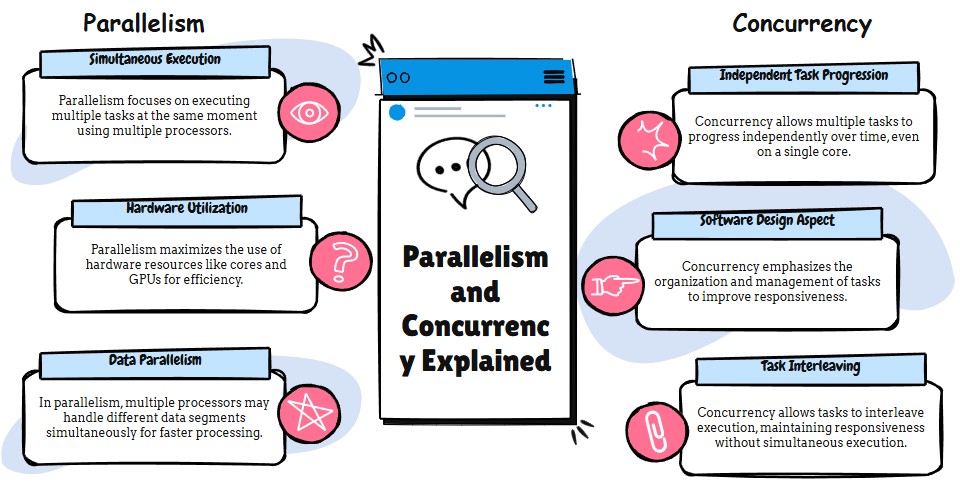
Understanding Parallelism
Parallelism focuses on simultaneous execution.
In a parallel system, multiple execution units, such as CPU cores, GPU processing units, or separate machines, perform operations at the same time. The work may consist of different parts of one large computation or multiple independent computations.
Parallelism is commonly used to:
- Reduce the execution time of one computational problem
- Increase the number of operations completed per unit of time
- Use multicore processors, GPUs, clusters, and other parallel hardware effectively
- Solve problems that would be too large or time-consuming for one execution unit
Example: Data-Parallel Model Training
Suppose a deep-learning model is trained using several GPUs.
Each GPU typically maintains a copy of the model and processes a different mini-batch or portion of the training data. The GPUs perform operations such as matrix multiplication and gradient computation simultaneously. Their gradients are then combined so that the model parameters can be updated consistently.
This approach is called data parallelism because the same computation is applied concurrently to different portions of the data.
Parallelism depends on hardware capable of simultaneous execution, but it is not purely a hardware concept. Programmers must also design parallel algorithms, divide the work, assign it to execution units, coordinate communication, and synchronize dependent operations.
The objective is often speedup, but parallelism can also improve throughput and hardware utilization.
Understanding Concurrency
Concurrency focuses on the composition, coordination, and progress of multiple tasks.
A concurrent program is structured so that several independent or interacting tasks can be active during overlapping periods. These tasks may execute by taking turns on one processor core, or they may execute simultaneously when multiple cores are available.
On a single core, the operating system or runtime can switch between tasks. At any instant, only one task may be executing, but multiple tasks make progress over time.
Concurrency is commonly used to:
- Keep applications responsive
- Manage many independent activities
- Overlap computation with input and output
- Organize complex software into interacting components
- Improve resource utilization and system throughput
Example: A Concurrent Web Server
Consider a web server that handles thousands of client connections.
Each connection may involve receiving a request, reading data from storage, querying a database, performing computation, and sending a response. Much of this work involves waiting for input, storage, or network operations.
Instead of allowing one request to block the entire server, the program can use threads, asynchronous I/O, coroutines, or an event loop to manage many requests concurrently.
On a single processor core, the server may interleave work among the requests. While one request waits for data, the server can make progress on another. On a multicore machine, some of those requests may also execute in parallel.
Concurrency therefore does not imply an absence of parallelism. It describes how tasks are structured and coordinated, regardless of whether the hardware executes them simultaneously.
A Simple Analogy
Imagine that you are preparing breakfast by yourself.
You start brewing coffee. While the coffee machine is working, you place bread in the toaster. While both machines are operating, you begin preparing an egg. You move among the activities and make progress on each one.
This is an example of concurrency. Several activities are in progress during overlapping periods, even though you personally perform only one action at a time.
Now imagine that three people prepare breakfast together. One person brews the coffee, another makes the toast, and a third cooks the egg. All three activities are performed at the same instant.
This is an example of parallelism.
The analogy also shows that concurrency and parallelism can occur together. The three people may work simultaneously, while each person also coordinates several activities.
Why the Distinction Matters
The distinction matters because concurrency and parallelism address different design questions.
Concurrency asks:
- How should multiple tasks be organized?
- How do tasks communicate and share data safely?
- What should happen when one task has to wait?
- How can the system remain responsive?
- How can every task continue making progress?
Parallelism asks:
- Which operations can execute simultaneously?
- How should the work be divided among execution units?
- How much speedup can additional resources provide?
- How much communication and synchronization are required?
- Is the workload balanced across the available hardware?
Concurrency often emphasizes software structure, coordination, and responsiveness. Parallelism often emphasizes simultaneous execution, performance, and hardware utilization.
These are not strict boundaries. Both concurrent and parallel programs may involve shared state, synchronization, communication, scheduling, and correctness challenges.
Systems Often Use Both
Modern systems commonly combine concurrency and parallelism.
Web Services
A web server may use concurrency to manage many active client requests. On a multicore system, different requests may also execute in parallel on different cores.
A computationally expensive request might itself contain parallel work, although many web servers obtain most of their parallelism by processing different requests simultaneously.
Data Pipelines
A data-processing pipeline may use concurrency to overlap reading, processing, and writing. While one stage reads the next block of data, another stage processes the current block, and another writes a completed result.
Within the processing stage, multiple cores or GPU units may operate on different data elements in parallel.
Desktop Applications
A graphical application may use concurrency to separate user-interface events, network activity, file operations, and background computation. It may also use parallelism to accelerate image processing, simulation, or rendering.
In short:
Concurrency is primarily about structure and coordination. Parallelism is primarily about simultaneous execution.
Comparison
| Aspect | Parallelism | Concurrency |
|---|---|---|
| Definition | Executing multiple operations simultaneously | Structuring multiple tasks so that their execution can overlap |
| Primary emphasis | Simultaneous execution | Task composition, coordination, and progress |
| Requires multiple execution units? | Yes | No |
| Can occur on one CPU core? | Not as simultaneous instruction execution | Yes, through interleaving |
| Common goals | Lower execution time, higher throughput, and better hardware utilization | Responsiveness, modularity, throughput, and effective resource management |
| Examples | Multicore computation, GPU kernels, SIMD instructions, and distributed parallel programs | Event loops, asynchronous I/O, GUI event handling, and operating-system multitasking |
| Common concerns | Decomposition, dependencies, communication, synchronization, and load balance | Shared state, communication, scheduling, synchronization, and progress |
| Possible failures | Data races, deadlocks, nondeterminism, communication overhead, and load imbalance | Data races, deadlocks, livelocks, starvation, and message-ordering errors |
The examples in this table are typical, not exhaustive. Threads, processes, message passing, and asynchronous programming can support concurrency, parallelism, or both, depending on how they are used and how the hardware executes them.
Summary
Parallelism means that multiple operations are physically executing at the same instant. It requires multiple execution units, such as CPU cores, GPU processing units, vector lanes, or separate machines.
Concurrency means that multiple tasks are active and make progress during overlapping periods. Concurrent tasks may be interleaved on one core or executed simultaneously across multiple cores.
The two concepts are related but not interchangeable:
- A system may be concurrent without being parallel.
- A system may use parallel execution as part of a larger concurrent design.
- Most modern systems combine concurrency and parallelism to different degrees.
Understanding this distinction helps programmers reason about two important dimensions of modern software: coordinating multiple activities correctly and using available hardware effectively.