

Goals of Parallelism
Modern computing tasks—such as real-time data analytics, scientific simulations, and deep-learning model training—often demand far more computation than a single processor core can handle efficiently. As processor clock speeds have plateaued due to physical and thermal limits, the path to higher performance now comes primarily from parallelism—performing many operations simultaneously.
Parallel computing allows large problems to be divided into smaller parts that execute concurrently, thereby reducing total execution time and enabling work that would otherwise be infeasible.
Why Parallelism
Parallel computing is about doing more in less time. However, the motivation goes beyond simply “running faster.”
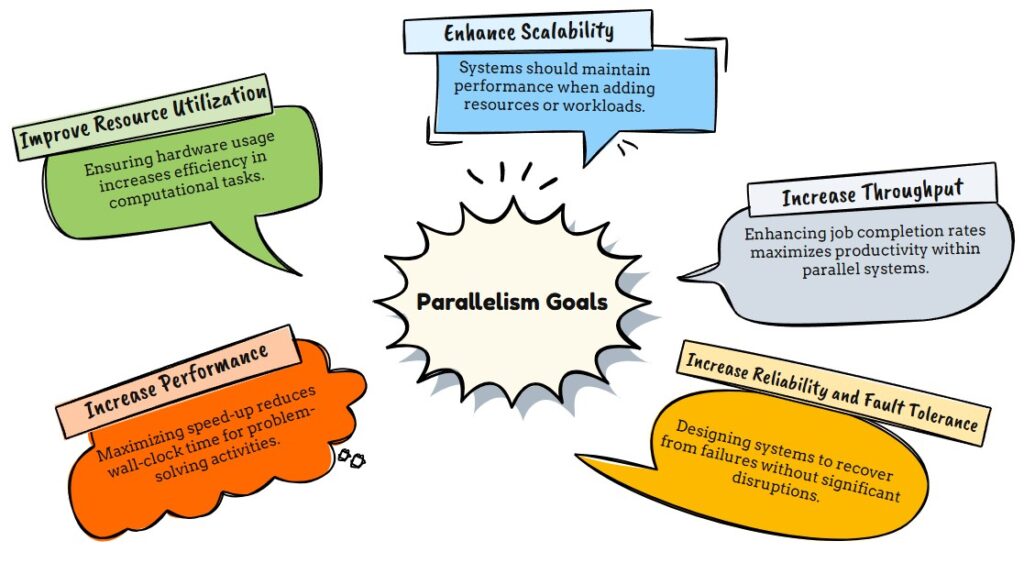
The fundamental goals encompass performance, scalability, efficiency, and reliability—each representing a critical dimension of modern computing systems.
⇒ Increase Performance
The most immediate and visible goal of parallelism is performance improvement—reducing the total wall-clock time needed to solve a problem.
Instead of executing instructions sequentially on one processor, a parallel system divides the workload across multiple processing units that operate concurrently.
Example:
Imagine processing a dataset of one billion numbers. If one processor can handle one million numbers per second, it would take roughly 1,000 seconds (about 16.6 minutes).
Using 10 processors, ideally, each would handle one-tenth of the data, completing the task in about 100 seconds—a 10× speed-up.
In practice, the speed-up is not perfectly linear because of overheads such as communication, synchronization, and data partitioning. Still, well-designed parallel algorithms often achieve near-linear speed-up for many problems.
Performance gains are often expressed in terms of speed-up (Sp = T1 / Tp), where T1 is the sequential execution time and Tp is the parallel execution time using p processors.
⇒ Increase Throughput
Performance measures how fast one job finishes, but throughput measures how many jobs complete per unit time.
Parallelism enables systems—especially servers and data centers—to process multiple independent tasks simultaneously.
Example:
-
A web server handling 1,000 client requests per second might use multiple worker threads or cores.
-
A GPU in a cloud service can process many users’ deep learning tasks concurrently.
By increasing throughput, parallel systems maximize productivity and support larger workloads, which is crucial in enterprise computing, cloud platforms, and real-time analytics environments.
⇒ Improve Resource Utilization
Modern computing hardware is inherently parallel—multi-core CPUs, vectorized instruction sets (SIMD), GPUs with thousands of threads, and even specialized AI accelerators.
However, without parallel software, most of these resources remain idle or underutilized.
Parallel computing ensures that available hardware is actively contributing to computation.
Consider a modern CPU: while one core is executing an intensive loop, others might sit idle unless the program is parallelized. Similarly, in a GPU with 10,000 cores, full utilization requires a high degree of data parallelism.
Effective resource utilization also involves:
-
Memory hierarchy management: Balancing data locality and minimizing cache misses.
-
I/O parallelism: Overlapping computation with input/output operations.
-
Hybrid acceleration: Combining CPUs, GPUs, and FPGAs where each performs tasks best suited to its architecture.
⇒ Enhance Scalability
Scalability refers to a system’s ability to maintain or improve performance as resources are added.
A well-designed parallel program should scale horizontally (adding more machines or nodes) or vertically (adding more cores or threads).
Two kinds of scalability are often discussed:
-
Strong scaling: How performance improves with more processors for a fixed total problem size.
-
Weak scaling: How performance holds steady when both the problem size and number of processors increase proportionally.
Example:
A weather or climate simulation that runs on 8 cores in one hour might run on 16 cores in about 30 minutes if the total problem size stays the same. This illustrates strong scaling—the program finishes faster as more processors are used for the same amount of work.
Suppose a program runs on 8 cores in 1 hour, and when we increase to 16 cores, it takes 45 minutes instead of the ideal 30 minutes. This is an example of not-so-good strong scaling. That means we doubled the number of cores but achieved less than 2× speed-up.
Now, suppose we double the amount of simulated data and also double the number of cores to 16, yet the program still completes in about one hour. This indicates good weak scaling—the system maintains performance even as both the workload and the number of processors increase proportionally.
Consider another situation — on 8 cores, the program processes 8 million data points in 1 hour. When scaled to 16 cores with 16 million data points (still 1 million per core), the runtime increases to 1 hour and 20 minutes. This is also an example of weak scaling, but the weak scaling is not so good.
True scalability requires minimizing sequential sections (per Amdahl’s Law, which is discussed later), reducing communication overhead, and designing algorithms that can balance workload evenly across all processors.
⇒ Increase Reliability and Fault Tolerance
In very large-scale systems—such as supercomputers, distributed databases, or cloud clusters—hardware or software failures are inevitable.
Parallel computing architectures can be designed to continue operation even when individual components fail, enhancing both reliability and fault tolerance.
Approaches include:
-
Replication: Running the same computation on multiple nodes and comparing results (common in mission-critical systems).
-
Checkpointing: Periodically saving the state of computation so that it can resume from a recent checkpoint after a failure.
-
Redundant computation or data storage: Using redundant arrays or replicated memory blocks to prevent data loss.
This reliability aspect distinguishes industrial-grade parallel systems from simple multi-threaded applications. It ensures that computation is both fast and dependable, which is vital in fields such as aerospace, finance, or healthcare analytics.
The Overarching Objective: Speed-Up with Correctness
Ultimately, all these goals converge toward a single overarching objective:
To achieve faster computation without compromising correctness or consistency.
Parallel computing must preserve the logical behavior of a sequential program while executing tasks concurrently.
Achieving this balance is nontrivial—improper synchronization can cause race conditions, deadlocks, or inconsistent results.
Therefore, an effective parallel system must not only accelerate computation but also:
-
Produce results identical (or acceptably close) to sequential execution,
-
Avoid unpredictable nondeterministic behavior, and
-
Remain maintainable and understandable for human developers.
Broader Implications
The goals of parallelism extend far beyond raw speed. They influence how we:
-
Design algorithms (favoring decomposability and minimal interdependence),
-
Build systems (favoring modular, concurrent components), and
-
Train future professionals (equipping them to think in parallel).
From smartphones with heterogeneous cores to exascale supercomputers, understanding these goals prepares students to reason about performance, scalability, and correctness in every computational context.